
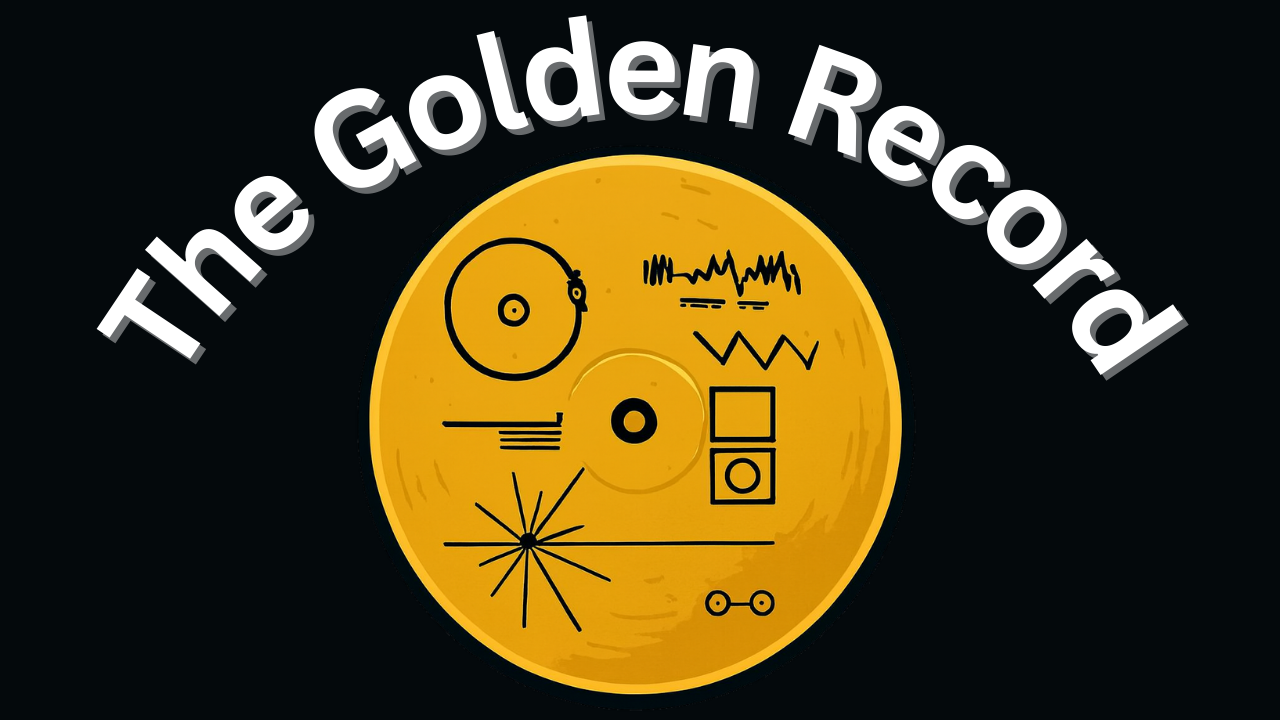
Right now, 14 billion miles away, there is a gold-plated record carrying the sounds of a heartbeat, a mother’s kiss, and the exact mathematical coordinates of Earth. But how do you explain ‘humanity’ to someone who has never seen a human?
Welcome to Nventer Labs. Today, we’re decoding a message meant to last a billion years.
WATCH AND LISTEN
READ ON
In 1977, humanity did something extraordinary. We sent a message in a bottle into the cosmic ocean, a time capsule designed to outlast our civilizations, our languages, even our species. Two identical golden records launched aboard the Voyager spacecraft, each one carrying the story of Earth into the infinite dark. These records weren’t meant for us. They were meant for someone, or something, that might find them a billion years from now, long after our sun has begun to die.
This is the story of the Voyager Golden Record: what it says, how it speaks, and why it matters.
THE BOTTLE IN THE COSMIC OCEAN
Carl Sagan called space “the cosmic ocean,” and the Voyager missions were humanity’s most ambitious voyage into those waters. Launched in the summer of 1977, Voyager 1 and Voyager 2 were designed to take advantage of a rare planetary alignment that occurs only once every 176 years. Their primary mission was to study Jupiter and Saturn, but everyone involved knew they would continue far beyond.
NASA assembled a small team to create something unprecedented: a message from Earth to anyone who might be listening. Led by Carl Sagan, with creative director Ann Druyan and a handful of scientists and artists, they had just six months to capture the essence of our entire world.
The format they chose was elegant and durable: a 12-inch gold-plated copper phonograph record. Not cassette tape, not digital media, but an analog disc that could theoretically be deciphered by any technological civilization. The cover was made of gold-plated aluminum, with instructions etched directly onto its surface: diagrams showing how to play the record, where Earth is located using pulsar maps, and even the proper speed of rotation.
But this wasn’t just a greeting card. It was a portrait of humanity at a specific moment in time: 1977, at the height of the Cold War, when nuclear annihilation felt possible, when we were just beginning to understand our place in the universe. The team faced an impossible question: how do you represent an entire planet?
ENCODING INFINITY
Here’s where the story becomes almost magical. The Golden Record contains 116 images, but here’s the problem: how do you store photographs on a phonograph record designed for sound?
The answer lies in one of the most ingenious hacks in the history of space exploration. The team converted each image into audio signals, essentially turning pictures into sound waves. Here’s how it worked.
First, each photograph was divided into a grid, essentially turning the image into thousands of individual points of light and dark. Each point was assigned a brightness value. Then these values were converted into electrical signals, with different voltages representing different brightness levels. Finally, these electrical signals were encoded as audio waveforms on the record.
To anyone just listening, these encoded images sound like harsh static or electronic noise, lasting about eight seconds each. But when fed through the right equipment and decoded properly, the static transforms back into photographs. The record included instructions for building the playback device, showing the first image in the sequence as a test pattern, like a Rosetta Stone for decoding all the others.
The images themselves tell a story. They begin with scientific diagrams: mathematical definitions, the structure of DNA, human anatomy. Then they move outward: photos of Earth from space, images of our continents and oceans, pictures of various landscapes. Finally, they show life: plants and animals, humans of different cultures, our cities and technologies.
The team could only include 116 images due to space limitations. Every single choice was agonizing. Which waterfall represents all waterfalls? Which face represents humanity? They settled on a woman from Guatemala breastfeeding, an elderly man with a cane, children of various ethnicities. One image shows a woman in a supermarket, an utterly mundane moment elevated to cosmic significance.
The record also contains 90 minutes of music from around the world: Bach and Beethoven, but also Chuck Berry, Peruvian panpipes, Japanese shakuhachi, Senegalese percussion, and a Navajo night chant. It includes spoken greetings in 55 languages, starting with ancient Sumerian and ending with Wu, a modern Chinese dialect. Each greeting is brief, personal: “Hello from the children of planet Earth.” “Peace and happiness to all.”
And then there are the sounds of Earth: a baby crying, a heartbeat, footsteps, laughter, a fire crackling, tools being used, a horse and cart, a train, a ship, a kiss. Ann Druyan contributed something deeply personal: her brain waves, recorded as she meditated on the history of Earth and her feelings about the project, including her love for Carl Sagan. Encoded in static on a golden disc, now floating through interstellar space, is a recording of a human being falling in love.
THE CONTROVERSIES
But creating a message for the cosmos meant navigating earthly politics and human biases, and the Golden Record team faced criticism from every direction.
The most infamous controversy involved nudity. The record includes line drawings of a nude man and woman, carefully designed to be anatomically accurate but not explicit. Even so, NASA received complaints. Some argued it was pornographic. Others pointed out a peculiar detail: the female figure has no visible genitalia, while the male figure clearly does. This decision was made to avoid controversy, but it created its own: we were willing to show aliens we exist, but not how we reproduce.
Another heated debate centered on what music to include. The team wanted to represent the diversity of human culture, but Western classical music dominates the recording. Some critics argued this reflected the bias of the predominantly Western committee. Others pointed out the practical constraints: they had limited space and were working under tremendous time pressure.
Then there was the question of what to leave out. The record shows humanity at its best: cooperation, art, exploration, love. There are no images of war, poverty, disease, or environmental destruction. No references to Hitler or Stalin, no mushroom clouds, no pollution. Carl Sagan defended this choice, arguing that these problems might be solved by the time anyone found the record, and besides, why emphasize our worst moments in a message meant to last a billion years?
But some critics saw it as dishonest, a sanitized portrait that ignored human cruelty and suffering. One team member suggested including a photo of the Great Wall of China, until someone pointed out it was built with slave labor. Every choice revealed uncomfortable truths about representation and legacy.
Perhaps the most profound debate was whether we should send the record at all. Some scientists worried that advertising our location to the universe was reckless. What if hostile aliens followed the pulsar map back to Earth? Carl Sagan argued the opposite: the record was more about us than them, a statement of hope that we would survive long enough to be worth finding.
There was also a subtle Cold War tension. The record needed to represent all of humanity, but it was funded by NASA, an American agency. Soviet music is on the record. Chinese greetings are included. But the predominant cultural perspective is undeniably Western. In trying to speak for Earth, the committee couldn’t escape speaking from Earth.
THE LONG GOODBYE
So where is the Golden Record now, and what are its chances of actually being found?
Voyager 1 is currently over 15 billion miles from Earth, traveling at about 38,000 miles per hour. It has left the solar system and entered interstellar space, the first human-made object ever to do so. Voyager 2 followed shortly after. Both spacecraft are now beyond the reach of the sun’s solar wind, drifting through the space between stars.
At their current speeds, the Voyagers will make their first close approach to another star system in about 40,000 years. But “close approach” in cosmic terms means passing within a few light-years, nowhere near close enough for gravitational capture. The records could drift through the galaxy, untouched and unnoticed, for billions of years.
The records were built to last. Gold doesn’t corrode in the vacuum of space. There’s no weathering, no erosion. The biggest threat is cosmic radiation, which will gradually degrade the metal, but even this will take hundreds of millions of years. NASA estimates the records could remain playable for a billion years, possibly longer.
But playable for whom? The galaxy contains an estimated 100 to 400 billion stars. Even if intelligent life is common, the odds of anyone finding a 12-inch disc drifting through the unimaginable vastness of space are essentially zero. Carl Sagan acknowledged this. He called it “a symbolic, hopeful gesture.”
Yet there’s something profound in the gesture itself. The Golden Record represents the moment when humanity became conscious of its cosmic context. We are small, isolated, ephemeral. Our sun will die. Our species will go extinct. But for one brief moment, we existed, and we were glorious enough to say so.
Frank Drake, who designed the cover’s instructions, put it beautifully: “The spacecraft will be encountered and the record played only if there are advanced spacefaring civilizations in interstellar space. But the launching of this bottle into the cosmic ocean says something very hopeful about life on this planet.”
CLOSING
Today, both Voyager spacecraft are still functioning, though their power sources are dying. NASA expects to lose contact with them sometime in the 2030s. After that, they’ll continue on in silence, no longer sending data home, but still carrying their message.
The Golden Record is the longest-term project humanity has ever undertaken. Not a bridge that might stand for centuries, not a cathedral built over generations, but an artifact designed to outlive our entire species. It will outlast every human achievement, every city, every monument. Long after Earth is gone, the Golden Record will still be out there, spinning through the dark.
Perhaps it will never be found. Perhaps it will drift through the cosmos forever, an unread letter, an unanswered call. But it exists. And in existing, it tells a story about who we were at this moment in time: a young species, newly aware of the universe, reaching out with hope and curiosity.
Carl Sagan once wrote, “The spacecraft will be encountered and the record played only if there are advanced civilizations in interstellar space. But the launching of this bottle into the cosmic ocean says something very hopeful about life on this planet.”
In 1977, we built a message for eternity. We encoded our music, our languages, our laughter, and our love into sound waves pressed into gold. We launched it into the infinite dark, knowing we might never know if anyone found it.
And perhaps that’s the point. The Golden Record isn’t really for aliens. It’s for us. It’s a reminder that we were here, that we loved this world, and that we dared to imagine we were worth remembering.
The bottle is in the cosmic ocean now, drifting beyond our reach. And it will be there, spinning silently through the stars, long after we’re gone.